9月8日至11日,联合国教科文组织(UNESCO)2026数字学习周(Digital Learning Week 2026)在巴黎总部举行。北京师范大学智慧学习研究院联席院长、联合国教科文组织人工智能与教育教席黄荣怀,受邀参加活动。
本届数字学习周以“人工智能时代的教育:真相、冲突、前沿(Education in the Age of AI: Facts, Frictions, Frontiers)”为主题,聚焦合成知识时代的事实辨识与证据基础、人工智能融入教育引发的矛盾与张力、教育创新的前沿图景,探讨智能时代教育“何以求真、何以应变、何以拓新”,强调维护教育的公共使命与人的主体性。
开幕式上,联合国教科文组织总干事哈立德·阿纳尼(Khaled El-Enany)、联合国副秘书长兼数字和新兴技术特使阿曼迪普·辛格·吉尔(Amandeep Singh Gill)分别致辞。联合国教科文组织教育助理总干事陈群主持开幕式,国际电信联盟秘书长多琳·博格丹-马丁(Doreen Bogdan-Martin)发表视频致辞。活动吸引来自世界各国、各地区的1500余名代表现场参会,包括20余位教育部长和特别代表,以及国际组织代表、专家学者、教育实践者、学生、企业代表等。
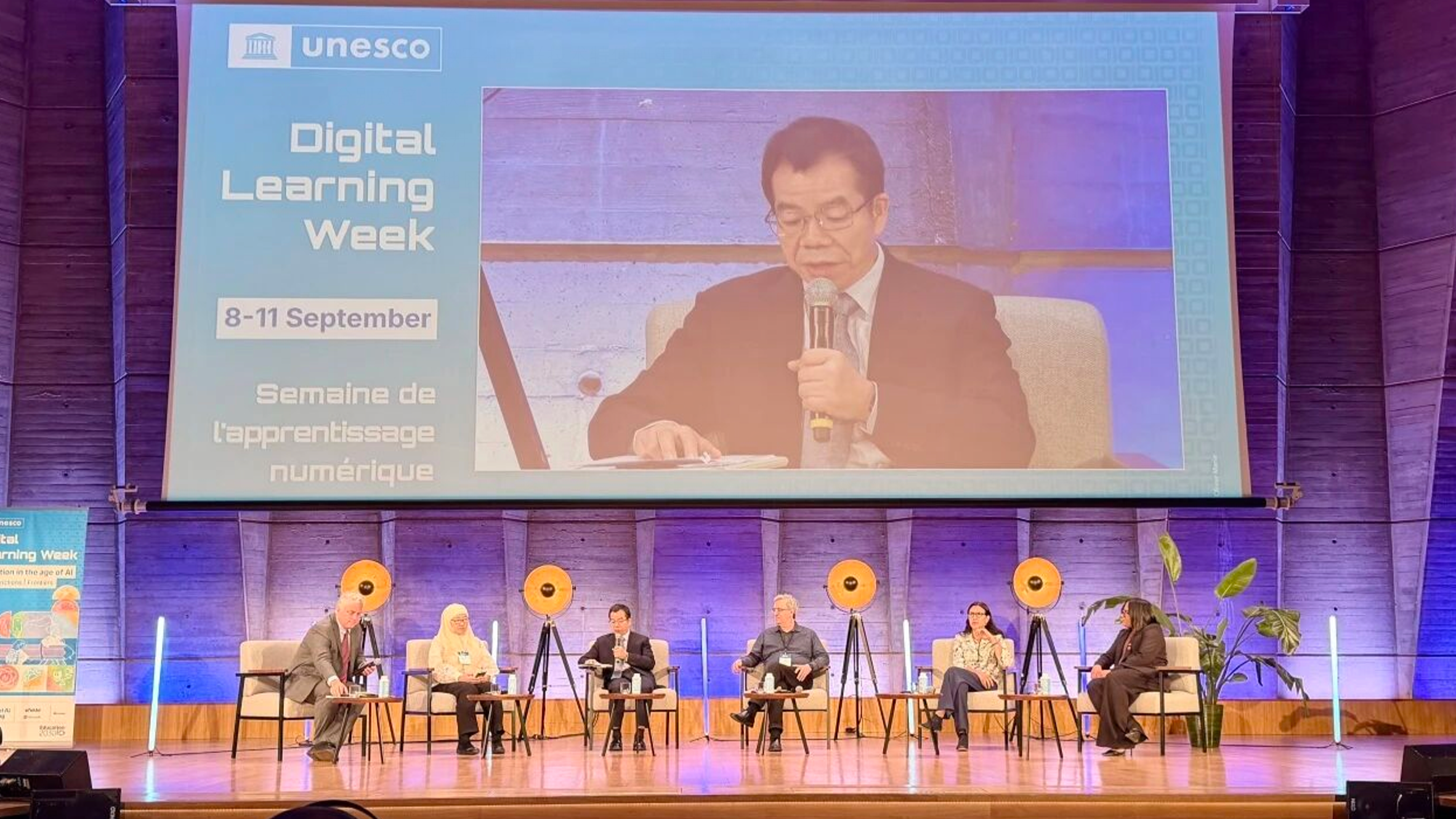
黄荣怀在联合国教科文组织数字学习周全体会议作交流分享
黄荣怀应邀参加全体会议,在“人工智能时代的高等教育人才培养与科学研究(Higher education: AI, talent ecosystems and research)”圆桌讨论上作交流分享,并参加了“跨学科人工智能高等教育应用(AI across disciplines in higher education)”平行会议等活动。
黄荣怀结合团队对30个国家100所高校人工智能创新实践的研究,概括当前高校人才培养的新趋势,表示面对新变化、新需求,高校应重新审视人才培养目标,着力关注学生持续终生的自主学习能力、利用人工智能的重新学习能力、多次灵活就业的适应能力、不确定性处置能力以及富智能环境中的生存能力。他还介绍了联合国教科文组织人工智能与教育教席牵头发起的智能教育社会实验。该研究立足真实教育教学场景,通过大规模、长期观察与跨学科研究,探索新兴技术影响教育变革的规律与机制,为人工智能在教育中的负责任应用提供实证支撑,助力实现教育可持续发展目标,为2030年后的教育发展议程提供参考。
数字学习周是联合国教科文组织推动数字学习与教育转型的年度旗舰活动,自2023年开办以来,活动汇聚政府部门、国际组织、学术机构和科技行业等各方代表,通过政策对话、研究交流与实践分享,深化国际合作,推动以人为本的教育数字化转型。
本届数字学习周发布多项成果文件,强调维护教育的公共属性,提出强化公共利益导向、保障教师主体性、培养学生批判性思维、促进公平包容等八项重点行动,旨在推动人工智能在教育中的负责任应用。此外,教科文组织还发布了新一年度高等教育人工智能调查结果,并就《在人工智能时代维护教育这一共同利益:协商治理的必要性》工作文件及6份背景文件开展全球咨询,聚焦人工智能安全、适龄应用、数字主权等议题,为各国完善教育领域人工智能治理提供研究支撑和政策参考。
UNESCO Digital Learning Week 2026 Held in Paris and BNU Professor Huang Ronghuai Invited to Share Insights
From September 8 to 11, UNESCO Digital Learning Week 2026 was held at UNESCO Headquarters in Paris. Professor Huang Ronghuai, Co-Dean of Smart Learning Institute of Beijing Normal University and Chairholder of the UNESCO Chair on Artificial Intelligence in Education, was invited to participate in the event.
With the theme “Education in the Age of AI: Facts, Frictions, Frontiers,” this year’s Digital Learning Week focused on fact identification and evidence-based approaches in the age of synthetic knowledge, the conflicts and tensions arising from the integration of artificial intelligence into education, and emerging frontiers in educational innovation. Participants explored how education can pursue truth, respond to change, and foster innovation in the age of intelligence, while emphasizing the preservation of education’s public mission and human agency.
At the opening ceremony, Khaled El-Enany, Director-General of UNESCO, and Amandeep Singh Gill, United Nations Under-Secretary-General and Envoy for Technology, delivered remarks. Chen Qun, UNESCO Assistant Director-General for Education, chaired the opening ceremony, while Doreen Bogdan-Martin, Secretary-General of the International Telecommunication Union (ITU), delivered a video address. The event brought together more than 1,500 participants from countries and regions around the world, including more than 20 education ministers and special representatives, as well as representatives of international organizations, experts and scholars, education practitioners, students, and business representatives.
Professor Huang Ronghuai was invited to participate in a plenary session and shared his insights at the roundtable discussion on “Higher Education: AI, Talent Ecosystems and Research.”
Drawing on his team’s research into AI innovation practices at 100 universities across 30 countries, Professor Huang summarized several emerging trends in talent development in higher education. First, greater emphasis is being placed on cultivating AI literacy.
Through general education courses and university-wide training, more students are being equipped with the ability to apply artificial intelligence. Second, greater attention is being given to interdisciplinary learning and practice-based education. Through university-industry collaboration, internships, practical training, and other approaches, institutions are promoting the integration of disciplinary learning with AI applications. Third, lifelong learning is receiving increased attention. Micro-credentials, flexible training, professional certification, and other pathways are being developed to support graduates in continuously updating their knowledge and enhancing their skills.
Professor Huang noted that, in response to new developments and emerging needs, universities should reconsider their talent development goals and place greater emphasis on students’ lifelong capacity for independent learning, their ability to relearn and adapt in an AI-enabled environment, their capacity to adapt to multiple forms of flexible employment, their ability to navigate uncertainty, and their ability to thrive in intelligent environments.
He recommended that governments strengthen overall coordination, incorporate AI literacy development into higher education priorities, increase investment in teacher training and shared educational resources, and provide targeted support to universities with relatively limited resources. Universities should deepen reforms in curriculum design, teaching, and assessment by integrating AI literacy into disciplinary education, thereby cultivating students’ independent thinking and autonomous judgment and laying a foundation for employment and lifelong learning. Research funding and academic evaluation mechanisms should also be adjusted accordingly. At the same time, however, human agency must remain central. Institutions should guard against excessive “cognitive outsourcing,” uphold academic standards, and ensure accountability for both research processes and conclusions.
Professor Huang also introduced the Smart Education Social Experiment, initiated under the leadership of the UNESCO Chair on Artificial Intelligence and Education. Based on real-world educational and teaching contexts, the initiative uses large-scale, long-term observation and interdisciplinary research to explore the patterns and mechanisms through which emerging technologies influence educational transformation. It aims to provide empirical support for the responsible use of AI in education, contribute to the achievement of the Sustainable Development Goals in education, and inform the post-2030 education development agenda.
During the conference, Professor Huang also participated in the parallel session on “AI across Disciplines in Higher Education” and other related activities.
About UNESCO Digital Learning Week
UNESCO Digital Learning Week is UNESCO’s annual flagship event promoting digital learning and educational transformation. Since its launch in 2023, the event has brought together representatives from government agencies, international organizations, academic institutions, and the technology sector. Through policy dialogue, research exchange, and the sharing of practical experiences, it seeks to deepen international cooperation and advance a human-centered digital transformation of education.
This year’s Digital Learning Week released a number of outcome documents. Emphasizing the public nature of education, the event proposed eight priority actions, including strengthening a public-interest orientation, safeguarding teachers’ agency, cultivating students’ critical thinking, and promoting equity and inclusion, with the aim of advancing the responsible use of artificial intelligence in education.
UNESCO also released the latest findings from its annual survey on AI in higher education and launched a global consultation on the working paper Safeguarding Education as a Common Good in the Age of Artificial Intelligence: The Need for Consultative Governance, together with six background papers. The consultation focuses on issues including AI safety, age-appropriate use, and digital sovereignty, providing research-based support and policy reference for countries seeking to improve AI governance in education.
相关链接:联合国教科文组织2026数字学习周举行,黄荣怀应邀参会并作交流分享