[Event Preview] Global Dialogue Forum on Open Universities in the Artificial Intelligence Era: Opportunities and Challenges
The latest trend in the global growth of higher education is the shift towards open universities (OU), as they are more cost-effective for governments compared to traditional universities and offer the opportunity to broaden access to university education for a larger population. During the COVID-19 pandemic, nearly all educational institutions were forced to close and transition to online teaching and learning. This experience has further underscored the advantages of open universities compared to traditional institutions. The reasons for advocating for a shift from traditional universities to open universities are further seen through the increasing demand for self-development and lifelong learning.w
The transition towards open universities reflects a broader transformation in higher education, driven by the need for accessibility, relevance, and adaptability in a rapidly changing world. As these institutions continue to evolve, they hold the potential to reshape educational landscapes and better meet the needs of diverse learners. Particularly in the Artificial Intelligence (AI) era, open universities have perhaps benefited the most from technological progress. Traditionally, open universities were at the forefront of using technology to overcome the traditional barriers of access, cost, and quality, and have thus become a valuable and integral part of the global higher education landscape. The emergence of generative AI tools like ChatGPT has significantly increased optimism about AI’s potential to transform open and distance education.
However, despite this increasing interest in open universities, many challenges still persist, including teaching quality, assessment, and learning engagement, among many others. Therefore, this forum aims to address the opportunities and challenges brought by AI generally and GenAI specifically for open universities as well as Open and Distance Learning.
 Forum topics
1. OU mechanisms for teaching and learning
2. OU business models to maintain its sustainability
3. AI policies in OU
4. AI implementation in open and distance learning (ODL)
5. AI adoption in management, decision-making and leadership
6. AI advantages in OU
7. AI challenges in OU
8. AI for micro credentials and certificates in OU
9. AI for quality assessment
Forum output
Case studies for different open universities worldwide participating in the forum will be compiled for a scientific Springer book.
Organizers
UNESCO Chair on AI in education, Beijing Normal University, China
Athabasca University, Canada
Open University of China, China
ALECSO, Tunis
Time
March 5-6, 2025
Venue
Offline Venue: Smart Learning Institute of Beijing Normal University, China
Online Venue: Zoom link: https://us06web.zoom.us/j/81561460421?pwd=saQjw3hYhaTp0wRn1XBPoMvaLXNxPk.1; Meeting ID: 815 6146 0421; Password: 25030506
Participating Open Universities (14):
Open University of China, China
Tianjin Open University, China
Zhejiang Open University, China
Open University of Shantou, China
Open University Malaysia, Malaysia
Anadolu University, Turkey
Open University of UK, UK
Athabasca University, Canada
Open University of the Netherlands, Netherlands
Universidad Internacional de La Rioja (UNIR), Spain
Al-Quds Open University, Palestine
Open University of Kenya, Kenya
Zambian Open University, Zambia
Open University of the Philippine, Philippine
Arab Smart University, Egypt
Experts (19)
Offline (11)
Dr. Ronghuai Huang, Professor and UNESCO Chair on AI in Education, China
Dr. Li Song, Vice President of the Open University of China, China
Dr. Zhang Zongwang, President of Tianjin Open University, China
Dr Wang Zhengdong, President of Zhejiang Open University, China
Dr. Ahmad Izanee Awang, Professor and President/Vice-Chancellor, Open University Malaysia, Malaysia
Dr. Rob Farrow, Senior Research Fellow, Co-Director Global OER Graduate Network, Open University of UK, UK
Dr. Ching Tan, Professor, Athabasca University, Canada
Dr Nantha Kumar Subramaniam - Deputy Dean, Faculty of Technology & Applied Sciences, Malaysia
Ms Shawira Abu Bakar - Deputy Director, Centre for Instructional Design and Technology, Malaysia
Dr. Ahmed Tlili, Associate Professor, Beijing Normal University, China
Dr. Asha Kanwar, Former President of the Commonwealth of Learning and Chair Professor, China
Online (8)
Dr. Daniel Burgos, Vice-rector for International Research, Universidad Internacional de La Rioja (UNIR), Spain
Dr. Halszka Jarodzka, Department Chair, Open University of the Netherlands, Netherlands
Dr. Aras Bozkurt, Dean of Open Education Faculty, Anadolu University, Turkey
Dr. Omwenga Elijah, Vice-Chancellor, Open University of Kenya, Kenya
Dr. Baldwin W. Kandinda, Dean School of Education, Zambian Open University, Zambia
Dr. Mahmoud Hawamdeh, Assistant Professor, Al-Quds Open University, Palestine
Dr. Melinda Bandalaria, Chancellor and Professor, Open University of the Philippine, Philippine
Dr. Ashraf Mohamed Elwany Farhat, Chairman of the Board and Legal Represetiative, Arab Smart University, Egypt
Dr. Beatriz Pont, Global Training Team Leader, UNESCO-IIEP
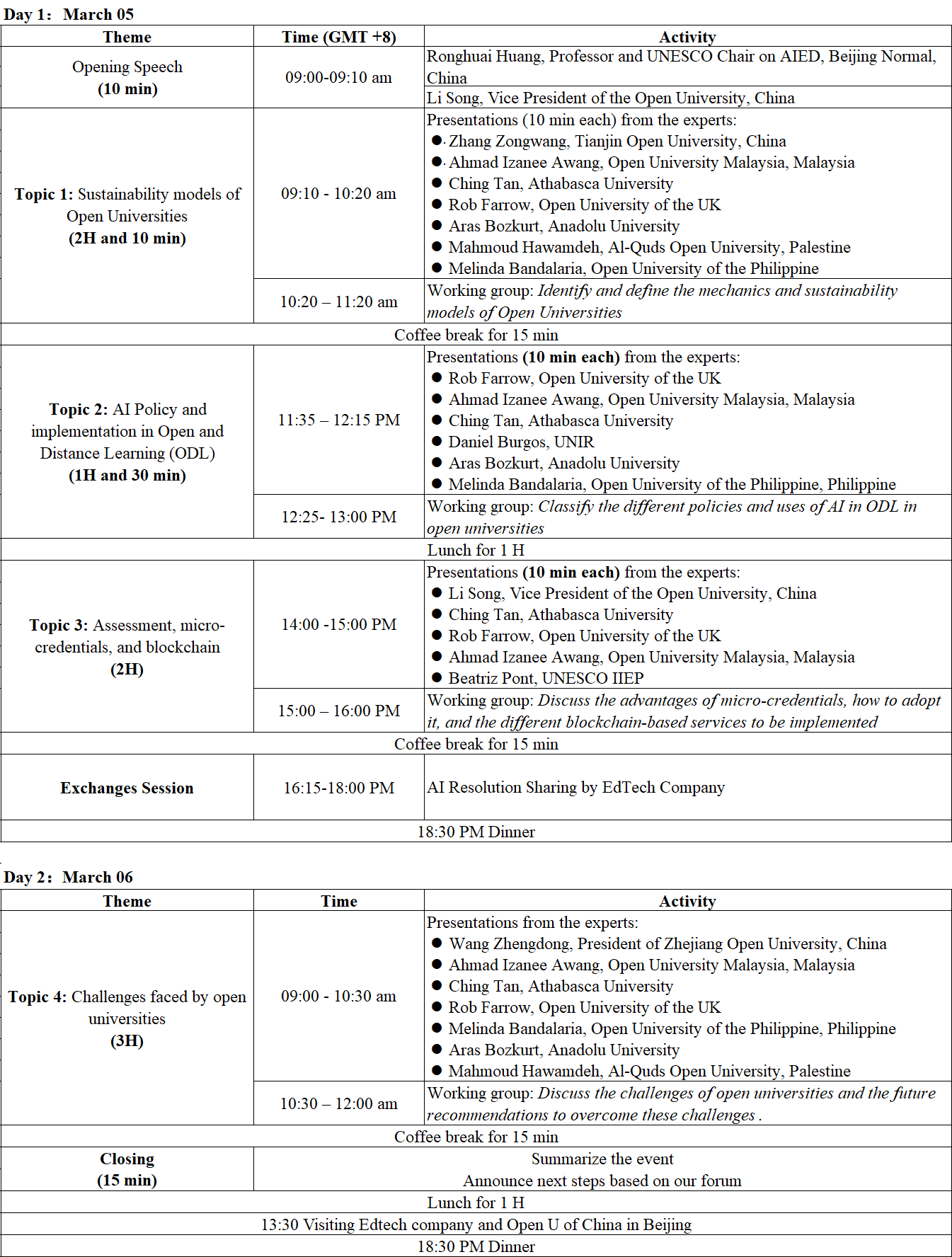
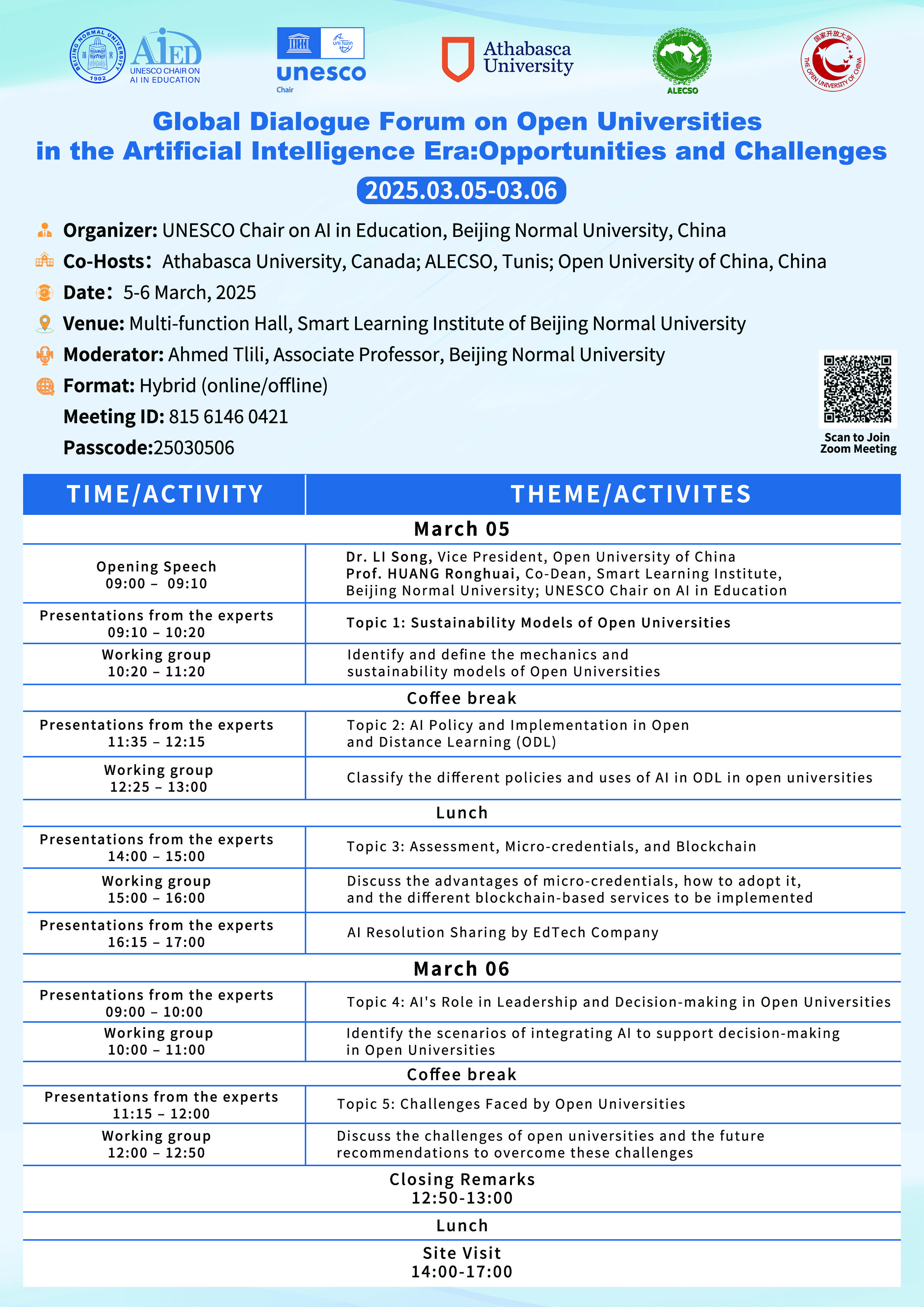
Schedule