
News
On January 15, during the 11th Smart Learning Week of Beijing Normal University (BNU), the online Briefing Session for the Global Competition on Design for Futures (GCD4F) 2026 was successfully held. Representatives from academia, industry, and youth innovation sectors engaged in discussions on how artificial intelligence (AI) can reshape inclusive education, drive scientific research, and contribute to human-centered social development. The session explored design-driven pathways to advance AI-empowered educational progress, scientific innovation, and social well-being. This event marks the official launch of the GCD4F 2026 and lays the foundation for subsequent international cooperation.
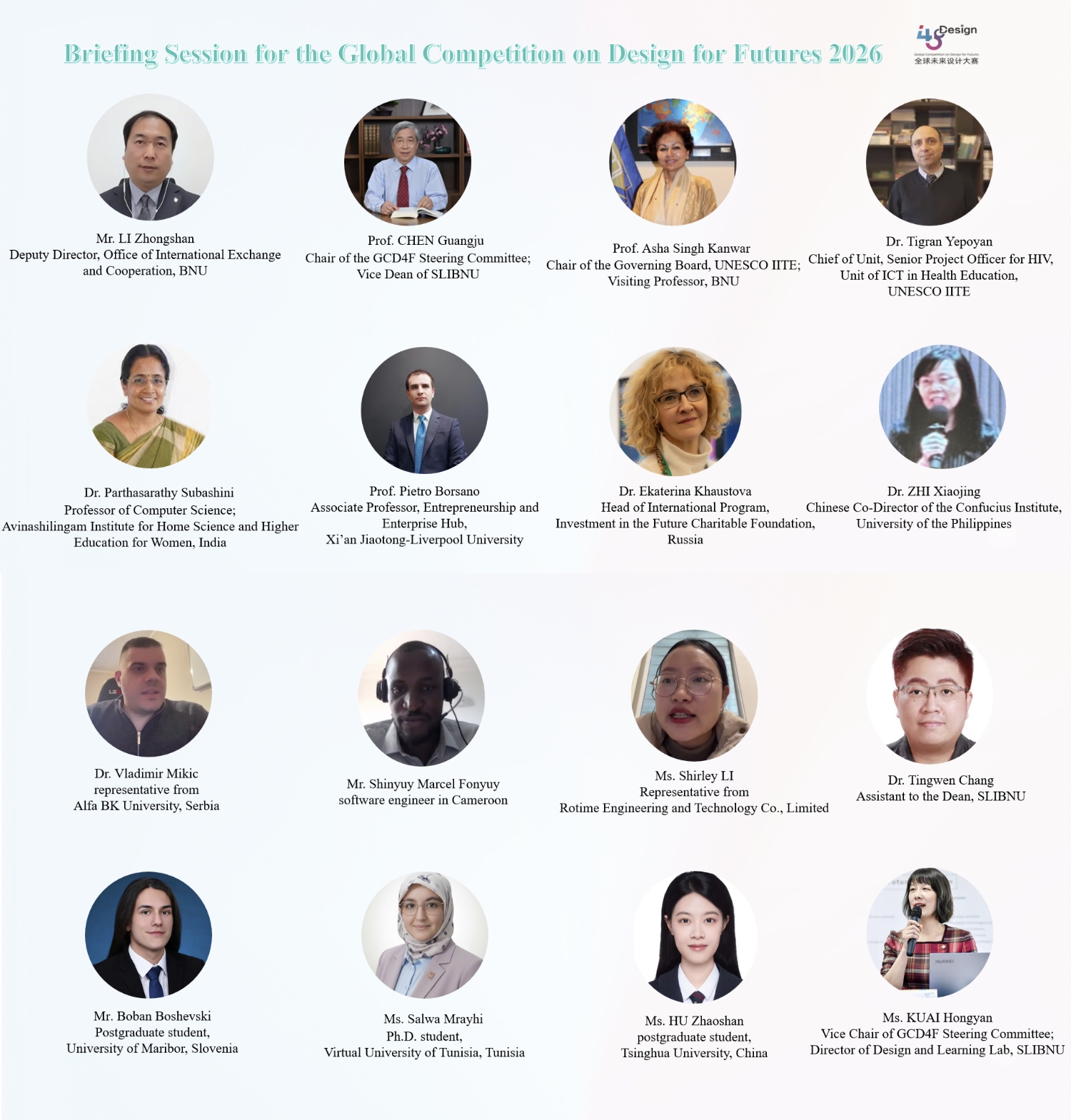
Mr. Li Zhongshan, Deputy Director of the Office of International Exchange and Cooperation at BNU, extended a warm welcome in his opening remarks to the distinguished guests, youth representatives, and partners in attendance. He also expressed gratitude to colleagues from various sectors for their long-standing support to BNU’s development and global educational innovation. He noted that since its joint launch in 2018 by BNU and the UNESCO Institute for Information Technologies in Education (UNESCO IITE), the competition has reached over 40 countries, attracted more than 10,000 participants, and generated thousands of innovative solutions. Mr. Li emphasized that BNU would continue to utilize the competition as a platform to empower the youth with interdisciplinary competencies and a global vision, foster high-level international exchange and cooperation, and contribute to cultivating future leaders who possess both a strong sense of national responsibility and a global perspective.
Deconstructing AI through Multiple Dimensions, Strengthening Theoretical Foundations
During the thematic speech session, three experts delivered in-depth presentations on core issues related to AI applications. They deconstructed pathways for technology-enabled empowerment from various perspectives, offering approaches that integrate theoretical depth with practical applicability.
Dr. Tigran Yepoyan, Chief of Unit, Senior Project Officer for HIV, Unit of ICT in Health Education, UNESCO IITE; Health and Well-being Education Advisor for Eastern Europe and Central Asia, UNESCO, highlighted that AI serves as a crucial driver in reshaping civilization. He emphasized that while leveraging its potential, it is essential to uphold ethical and human-centered boundaries, guard against risks such as cognitive erosion and privacy breaches. He recommended integrating smart education into curricula, strengthening the development of students’ socio-emotional competencies, promoting AI literacy education, and consistently ensuring that teachers maintain a guiding role in the application of technology.
Dr. Parthasarathy Subashini, Professor of Computer Science; Coordinator, Centre for Machine Learning and Intelligence, Avinashilingam Institute for Home Science and Higher Education for Women, India, pointed out that AI brings significant breakthroughs to educational research, enabling large-scale personalized diagnostics, dynamic assessment, and precise intervention. She proposed the "digital twin curriculum" framework, suggesting the integration of virtual reality and augmented reality technologies to create immersive learning environments that enhance both teaching experience and outcomes. However, challenges such as high hardware costs and difficulties in technology adaptation remain and require attention.
Dr. Pietro Borsano, Associate Professor of Entrepreneurship and Enterprise Hub, Xi’an Jiaotong-Liverpool University, emphasized that the transformation of innovation ecosystems should be built upon three pillars: policy guidance, market demand, and cross-regional collaboration. He introduced the "Sense-Capture-Reconstruct" dynamic capability framework and illustrated pathways for institutional and technological integration using the transformation of Hong Kong's space technology ecosystem as an example. He stressed that AI can break down industrial barriers, promote technology spillover, thereby injecting diversified momentum into social development and contributing to the realization of human-centered goals.
Sharing Practical Cases, Promoting the Technology for Good
During the case-study sharing session, three award-winning contestants from different countries and regions shared their practical experiences, presenting AI application cases, technical solutions, and core reflections in the field of education. Their contributions showcased the innovative vitality and sense of responsibility of the youth worldwide.
Boban Boshevski, postgraduate student at the University of Maribor, Slovenia and a silver award winner of the 2025 competition, introduced four key application scenarios of AI in education: adaptive learning, intelligent assessment, predictive intervention, and interactive tools. In response to potential "information hallucination" issues posed by AI, he suggested the use of Retrieval-Augmented Generation (RAG) technology. He emphasized that the application of AI must prioritize fairness and ethics, guard against risks such as data bias, privacy breaches, and over-reliance on technology, and adhere to the fundamental principle of technology for good.
Salwa Mrayhi, Ph.D. student at the Virtual University of Tunisia and a silver award winner of the 2021 competition, proposed a framework named NEIUDNWCAG. This framework integrates the Web Content Accessibility Guidelines (WCAG) and the principles of Universal Design for Learning (UDL), leveraging AI technology to enable multimodal presentation of educational content and real-time interactive feedback. It aims to remove participation barriers and provide personalized support for learners with disabilities and other groups, thereby advancing the practice of educational equity.
Hu Zhaoshan, postgraduate student at Tsinghua University and recipient of the Excellent Technology Innovation Award in the 2025 competition, shared an AI-assisted system designed for group discussions in secondary school classrooms. The system promotes a shift from outcome-based to process-oriented teaching evaluation by visualizing discussions in real time, balancing student participation, and documenting learning trajectories, thus more accurately reflecting students’ developmental progress. She emphasized that the application of AI in classrooms should align with the goals of “making learning visible, equitable, and supportive,” truly serving the optimization of teaching and student development.
Clarifying Competition Positioning, Charting the Developmental Blueprint
During the competition release session, the vision of the GCD4F 2026 was jointly interpreted by Prof. Chen Guangju, Chair of GCD4F Steering Committee and Vice Dean of the Smart Learning Institute of Beijing Normal University (SLIBNU); Prof. Asha Singh Kanwar, former Chair of the UNESCO IITE Governing Board and Vice Dean of SLIBNU; and Ms. Kuai Hongyan, Vice Chair of GCD4F Steering Committee and Director of the Design and Learning Lab of SLIBNU.
Prof. Chen Guangju pointed out that the competition, as one of the annual important events of the World Digital Education Alliance (WDEA) and supported by institutions including the Chinese Education Association for International Exchange, is dedicated to building a sustainable platform for international cooperation. It aims to pool the wisdom of youth worldwide to address contemporary challenges. In 2026, the theme of the competition has expanded from education to encompass science and social sustainable development, responding to the UN’s "International Decade of Sciences for Sustainable Development (2024–2033)" and engaging global youth in tackling shared human challenges. Prof. Chen emphasized that the youth is the core force driving change. The competition will serve as a "testing ground" for their ideas, helping them enhance their design thinking, global competence, and leadership by addressing real-world challenges, and collectively building a more equitable, smart, and sustainable future.
Prof. Asha Singh Kanwar stated that the GCD4F 2026 is not merely a contest but an international platform fostering collaboration and innovation. She highlighted four core principles guiding the competition: first, we need innovations that can lead to action; second, we need human-centered innovation; third, we need to contribute to specific solutions for the vulnerable and marginalized; fourth, we need to co-create innovations across different disciplines. Co-organized by BNU and UNESCO IITE, this competition is committed to not just inspiring innovations but also promoting the outstanding outcomes on our global networks. It invites youth from different regions to engage with real-world challenges, develop responsible innovation, and contribute to a more equitable and sustainable future.
Ms. Kuai Hongyan systematically reviewed the competition’s development journey and highlighted the guiding principles, event schedule, and submission categories for this edition. She noted that the 2026 competition features three main tracks: “AI for Science,” “AI for Education,” and “AI for Society,” encouraging participants to leverage AI technologies in driving innovation for sustainable development. She particularly emphasized that the regional finals have established a collaborative ecosystem characterized by “hosting by universities, support from enterprises, and coordination with embassies/consulates.” This model has been successfully implemented across multiple regions, including Southeast Asia, South Asia, and Central and Eastern Europe. By empowering the youth worldwide to tackle future challenges through innovation, the competition contributes to fostering inclusive, smart, and sustainable global development.
Building Cross-Regional Consensus, Fostering Resource Synergy
During the regional cooperation session, representatives from Southeast Asia, Eastern Europe and Central Asia, Africa, Central and Eastern Europe, and South Asia shared local practical experiences in digital education, technological innovation, and social development. Participants included Dr. Zhi Xiaojing, Chinese Co-Director of the Confucius Institute at the University of the Philippines; Dr. Ekaterina Haustova, Head of International Program, Investment in the Future Charitable Foundation; Mr. Shinyuy Marcel Fonyuy, Software Engineer from Cameroon; Dr. Vladimir Mikic, Representative of Alfa BK University in Serbia; and Ms. Shirley Li, Representative of the Rotime Engineering and Technology Co., Limited. They also put forward cooperation proposals based on regional educational technology landscapes and youth innovation needs. The representatives agreed that the competition should serve as a platform to foster collaboration among universities, enterprises, and research institutions within and across regions. By integrating resources, sharing technological outcomes, facilitating talent exchange, and supporting project incubation, the initiative can help break down geographical and cultural barriers, contribute to sustainable development in each region, and collectively advance the global educational endeavor.
This briefing session effectively synergized the wisdom of experts and the vision of youth, clarifying the competition’s upgraded framework and regional collaboration mechanisms. The conference marks the official launch of the GCD4F 2026 and establishes an international platform for global youth to exchange insights, learn from one another, and engage in collaborative innovation. This initiative will significantly contribute to fostering the responsible application of AI in education, science, and society, promoting sustainable development, and offering innovative solutions to global challenges.
GCD4F Website: https://gcd4fe.bnu.edu.cn/en/index.html